Brand Authority Hub
Sell Your Rolex in Sydney: The Complete Owner's Guide
Rolex is the most traded luxury watch brand in the world, and by far the most common watch we are asked to buy in Sydney. If you have inherited a Datejust, upgraded out of a Submariner, or are quietly deciding whether to part with a Daytona, this guide is written to help you understand your watch, the market it sits in, and exactly how a private sale works.
Sell My Watch Co is an Australian-owned, Sydney-based watch buyer. We are the buyer, not a marketplace or a broker taking a commission. That means no public listings, no auction fees, no waiting on a stranger to commit, and no exposure of your details. You deal with us directly, your watch is inspected by an independent horologist, and cleared funds reach your account before the watch leaves your hands.
This is reference material first and a sales page second. Read as much or as little as you need. When you are ready for a private, no-obligation assessment, you can request a valuation online or call 0485 511 177.
Why sell your Rolex to Sell My Watch Co
Selling a Rolex privately can feel daunting: there are grey dealers, overseas buyers, auction houses, consignment shops and online platforms, each taking a cut or carrying a risk. We built our service to remove that friction for Sydney sellers who value privacy and a straight answer.
We are the buyer
You are not waiting for a third party to commit. We assess your Rolex and make our own decision, so there is no listing period, no commission and no buyer to chase.
Same-day cleared payment
Once your watch is inspected and a price is agreed, payment is made the same day. Cleared funds reach your nominated account before the watch leaves your possession.
Independent inspection
Your Rolex is examined by a professional, independent horologist who assesses authenticity, condition and originality, rather than a commission-driven salesperson.
Genuine discretion
Your watch is never publicly listed and your personal details, invoices and purchase history are never circulated. Many of our clients value privacy as much as price.
Australian owned and based
We are based in Sydney and operate under Australian law, with private appointments across the city and secure options for interstate sellers.
No pressure, no obligation
A valuation and inspection are free. If our figure is not right for you, you keep your watch and we part on good terms.
Why Rolex holds its value
Few possessions hold value the way a well-kept Rolex does. The reasons are not mysterious: Rolex builds a relatively tight, carefully managed catalogue, controls production closely, and has spent decades earning a reputation for quality and consistency. The result is a brand that is recognised and trusted almost everywhere in the world, which in turn keeps demand broad and durable.
Because supply at authorised dealers is limited for many popular references, the secondary market carries real weight. A buyer who wants a particular steel sports model often cannot simply walk in and buy one at retail, so well-kept pre-owned examples remain genuinely sought after. That underlying demand is the foundation of Rolex resale value, and it is why a considered private sale can be a sensible alternative to trading in or listing publicly.
It is worth being realistic, too. Rolex values are strong but not fixed; they move with model, condition, completeness and the wider market. The point of this guide is to help you understand what actually drives the figure for your specific watch, so that whatever you decide, you are deciding with clear information.
Understanding the Rolex catalogue
The Rolex range splits broadly into two worlds. The Professional, or tool, line includes the Submariner, GMT-Master II, Sea-Dweller, Deepsea, Explorer, Explorer II, Yacht-Master, Air-King and the discontinued Milgauss, watches originally designed for diving, travel, exploration and science. The Classic line is led by the Datejust and the Day-Date (the President), with the Oyster Perpetual as the time-only foundation and the Cosmograph Daytona sitting at the top of the chronograph hierarchy. The dress-oriented Cellini line sits apart from the Oyster family.
Within each model, value is driven by the specific reference, the materials (Oystersteel, Rolesor two-tone, white, yellow or Everose gold, and platinum), the dial and bezel configuration, and the production period. Two watches that look almost identical can sit far apart in desirability once the reference and configuration are taken into account, which is why the reference number matters so much when you come to sell.
How the Rolex secondary market behaves
Demand for Rolex is broad, but it is not uniform. Steel professional models, particularly the Submariner, GMT-Master II and Daytona, have historically been the most liquid and the most consistently sought after, because they combine everyday wearability with strong brand recognition and constrained supply. Precious-metal and gem-set pieces appeal to a narrower but committed audience, and can take a little longer to place even when they are beautiful watches.
Vintage Rolex follows its own logic. For older references, originality, dial condition, patina and provenance can matter more than completeness, and small details separate an ordinary example from a special one. Modern watches, by contrast, are valued more on condition, completeness and current demand for the reference. Knowing which world your watch belongs to is the first step in understanding its value.
Current Market Insights
Updated June 2026Rolex remains the most liquid segment of the watches we buy in Sydney. Interest in steel professional models is steady, with buyers continuing to prioritise originality and complete, honest examples. Precious-metal and gem-set pieces remain selective but find the right home when the configuration is desirable.
Strongest collector interest: Submariner, Daytona, GMT-Master II.
Reading the Rolex market
The Rolex secondary market moves, sometimes noticeably. Steel sports references have historically been the most resilient, but no segment is immune to wider sentiment, currency movements and shifts in collector taste. When you read headlines about prices rising or falling, they usually describe broad averages across a few headline references, not the specific watch on your wrist.
What this means in practice is straightforward: the best time to sell is when it suits you, with a clear, current assessment of your particular reference rather than a number from an old article or a marketplace listing for a different configuration. We keep our reading of the market deliberately qualitative and honest. We will tell you where demand sits for your watch today, without inventing a precise figure to win your business.
Understanding Rolex reference numbers
Every Rolex carries a reference number, usually engraved between the lugs at the 12 o'clock side, beneath the bracelet. It is the single most useful piece of information when valuing a watch, because it identifies the exact model, material and configuration far more precisely than a name like "Submariner" ever could. A five-digit reference generally points to an earlier generation, while modern watches typically carry a six-digit reference, often with letters indicating the material, for example a code denoting steel, two-tone or solid gold.
Alongside the reference is a serial number, historically engraved between the lugs on the opposite side and, on modern watches, also etched in tiny lettering on the rehaut (the inner bezel ring around the dial). Together these numbers help establish the production period and confirm that the case, dial and components belong together. You do not need to decode any of this yourself; if you can photograph the watch clearly, including between the lugs where possible, we can identify the reference and explain what it means for value.
If you cannot find the numbers or are unsure, that is completely normal. They are deliberately discreet and can be hard to read. Send what you have, including the original papers if you hold them, and we will take it from there.
Where your Rolex sits in the market
A simple, qualitative way to think about liquidity and demand across the range. These are general tendencies, not guarantees. Every watch is assessed on its own merits.
| Category | Typical demand | Liquidity | What buyers prioritise |
|---|---|---|---|
| Steel sports (Submariner, GMT, Daytona) | Strong and broad | High | Condition, completeness, original parts |
| Steel classics (Datejust, Oyster Perpetual) | Steady | High | Condition, dial colour, popular sizes |
| Two-tone & precious metal | Selective | Moderate | Configuration, condition, taste-driven demand |
| Gem-set & dress (Day-Date, Cellini) | Narrower | Moderate | Materials, originality, presentation |
| Vintage references | Specialist | Varies | Originality, dial condition, provenance |
We buy across all of these categories. Where a watch sits here affects how quickly it moves and how the market values it, not whether we are interested.
Rolex models we buy
We buy across the entire Rolex range, modern and vintage, in steel, two-tone and solid gold. Below are the families we are asked about most often. Where a detailed model guide already exists you can follow the link to read more; the rest are listed so you can see the breadth of what we consider.
What determines your Rolex offer
An honest offer is built from the watch itself, not a formula applied sight unseen. These are the factors an independent horologist weighs when assessing a Rolex, and the things you can point us to when you first make contact.
Model and reference
The exact reference identifies the model, material and configuration, and is the strongest single driver of value.
Condition of the case
Whether the case retains its original lines and proportions, or has been heavily polished, which removes metal and softens edges that collectors notice.
Dial, hands and bezel
Originality and condition of the dial, hands and bezel; service-replacement parts and any refinishing are noted, as they affect value differently on modern and vintage watches.
Movement and service history
Whether the movement runs correctly and within tolerance, and whether it has a documented service history. A recent service from a reputable watchmaker can support the assessment.
Bracelet and clasp
Condition, stretch and originality of the bracelet and clasp, and whether the correct bracelet is fitted for the reference, including spare links.
Completeness
Original box, warranty card or guarantee, booklets, service papers and any extras. These help but are not mandatory.
Originality overall
Whether the watch is correct and unmodified; aftermarket dials, bezels, diamonds or other changes are assessed separately from factory-original examples.
Current market demand
How sought after the specific reference is at the time you sell, which can move with the wider market.
Ready for an honest, no-obligation assessment of your Rolex? Send a few photos and details and we'll come back quickly.
Box, papers and what they mean for value
A "full set" (the watch with its original box, warranty card or guarantee, booklets and any extras such as spare links, hang tags or a service receipt) generally presents best and can support a stronger result, particularly on modern watches where buyers expect completeness. The original purchase documentation also helps confirm provenance and the production period.
That said, box and papers are not mandatory, and a watch without them is far from unsellable. We buy full sets, partial sets and watch-only examples every week. On vintage references in particular, an honest, original watch can be more desirable than a tidy but altered one, regardless of whether the paperwork survived. If you have anything at all, even just the booklet or an old service docket, it is worth including, but please do not let missing paperwork stop you from making contact.
If you are missing your warranty card, never alter or recreate documentation. We would always rather assess an honest watch-only example than see fabricated paperwork, which undermines trust and value for everyone.
Service history and condition
Rolex movements are robust and built to run for decades, but like any mechanical watch they benefit from periodic servicing. A documented service history from Rolex or a reputable independent watchmaker reassures a buyer that the watch has been cared for and is running as it should, and it can support the assessment of an otherwise strong example.
A service is not a requirement to sell, and you should not rush out to have a watch serviced purely to sell it. The cost may not be recovered, and an unnecessary service can occasionally do more harm than good if parts are replaced. What matters more is honesty about the watch's condition: if it has been running poorly, gaining or losing time, or sitting unworn for years, simply tell us. We assess every watch on its actual condition, and an accurate description from the outset makes for a faster, smoother process.
Avoid having a watch "polished up" before selling. Well-intentioned polishing by a non-specialist can round the case edges and remove original finishing, which reduces value rather than adding to it. When in doubt, leave the watch as it is and let an independent horologist assess it.
How authentication and selling works
The process is deliberately simple, private and free of pressure. Here is exactly what happens from your first message to cleared payment.
-
1
Send your watch details
Share the model, reference if you have it, condition, if you hold box and papers, and a few clear photos, including between the lugs if possible. You can do this online or by phone.
-
2
Receive a price indication
We review what you have sent and usually respond within 24 hours, often sooner, with a clear, honest price indication based on the information provided.
-
3
Arrange a private appointment
If the indication suits you, we arrange a private appointment in Sydney, or a secure process for interstate sellers. There is no obligation to proceed.
-
4
Independent inspection and authentication
An independent horologist inspects and authenticates the watch in person, assessing condition, originality and completeness. We may request photo ID and proof of ownership for security.
-
5
Agree a final price
After inspection we confirm a firm price. If it works for you, we proceed; if not, you keep your watch and there is nothing more to do.
-
6
Same-day cleared payment
Once the price is agreed, payment is made the same day, with cleared funds in your nominated account before the watch leaves your possession.
How payment works
Payment is made by secure bank transfer into your nominated Australian account. Crucially, we wait for the funds to clear into your account before the watch changes hands. You are never asked to hand over a valuable Rolex on a promise. This is the single most important protection for a private seller, and it is standard for every transaction we complete.
Once your Rolex has been inspected, authenticated and a price agreed, payment is processed the same day. For larger amounts, ordinary banking limits and clearance times can apply, and we will be upfront about timing so there are no surprises. The goal is simple: a secure, transparent settlement where you are paid in full, in cleared funds, before you part with your watch.
Common Rolex selling mistakes to avoid
Most problems sellers run into are avoidable. A few things worth keeping in mind before you sell any Rolex, whether to us or anyone else.
Avoid: Over-polishing before sale
Better: Leave the watch as it is. Heavy polishing removes metal and softens the case, reducing value. Let an independent horologist assess the original condition.
Avoid: Handing over the watch before payment clears
Better: Never release a watch on a promise. Insist on cleared funds in your account first, exactly how we operate.
Avoid: Assuming missing papers make it unsellable
Better: Watch-only examples sell every day. Send what you have; the absence of paperwork lowers nothing to zero.
Avoid: Accepting the first online lowball
Better: Get a considered, in-person assessment before committing. A quick anonymous offer rarely reflects a watch's real condition.
Avoid: Recreating or altering documentation
Better: Never fabricate papers. Honesty protects value and trust; an original watch-only example is always preferable to altered paperwork.
Avoid: Shipping to an unknown overseas buyer
Better: Selling locally to a known, accountable buyer removes shipping risk, payment risk and the loss of any recourse if something goes wrong.
Avoid: Not knowing the reference
Better: You do not need to decode it yourself. Just photograph the watch clearly, including between the lugs, and let us identify it.
Recent Purchases
Recent Rolex purchases.
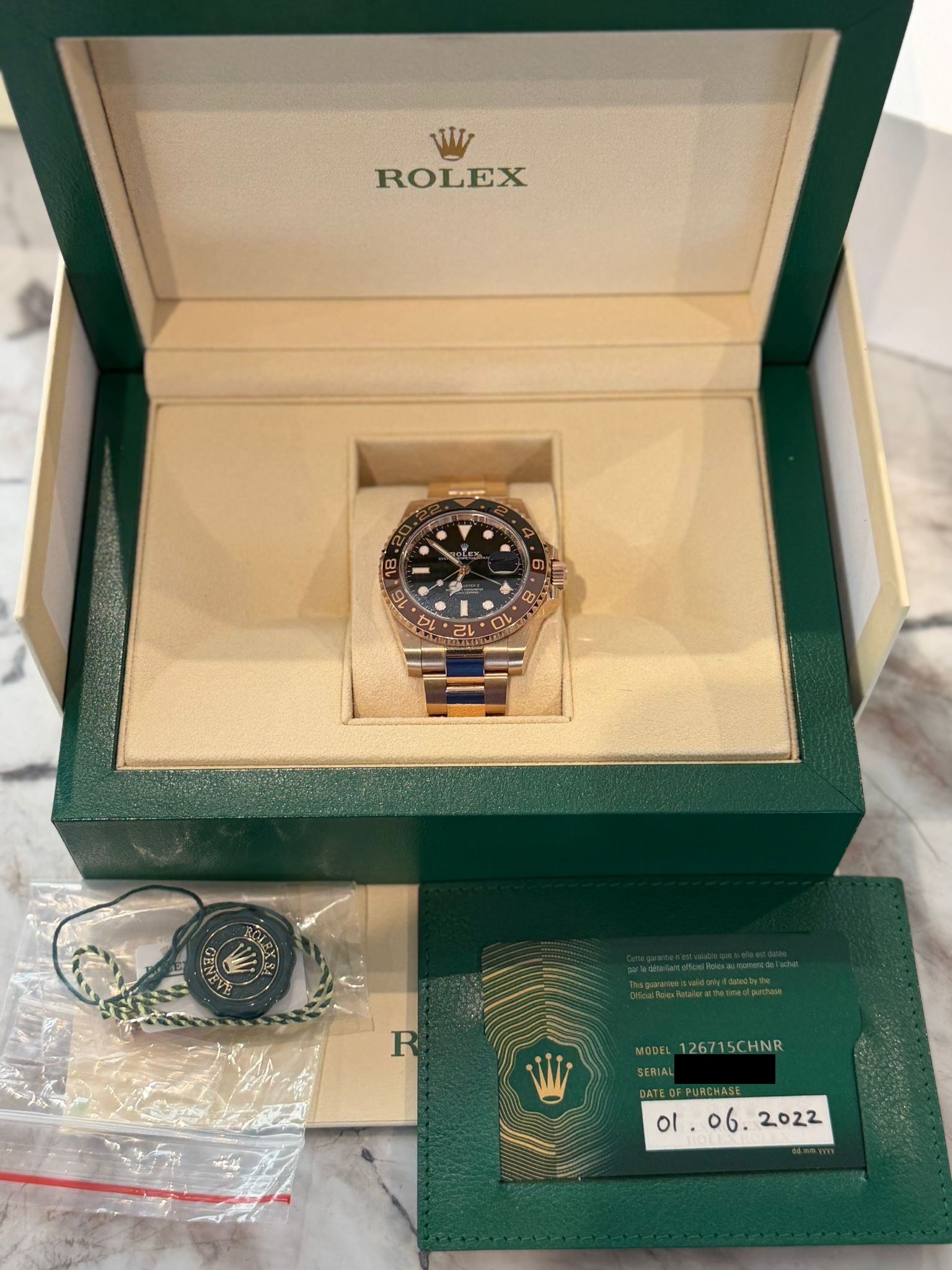
Client discretion is important to us. Watches shown in our Recent Purchases section are only published where the seller has granted permission. All transactions remain private and confidential unless approval is provided.
FAQs
Common questions, straight answers.
- How much is my Rolex worth?
- It depends on the exact reference, the watch's condition and originality, whether you have the box and papers, and current demand for that model. Send the model, reference and a few clear photos and we'll come back with an honest price indication, usually within 24 hours. A firm figure is confirmed once the watch is inspected in person.
- Which Rolex models do you buy?
- We buy across the entire Rolex range, including the Submariner, Daytona, GMT-Master II, Datejust, Day-Date, Sky-Dweller, Sea-Dweller, Deepsea, Yacht-Master, Explorer, Explorer II, Oyster Perpetual, Milgauss, Air-King and Cellini, as well as vintage references, in steel, two-tone and solid gold, modern and vintage.
- Can I sell my Rolex without the box and papers?
- Yes. We buy full sets, partial sets and watch-only examples. Original box and papers can support the assessment, but their absence does not prevent a sale. Send whatever you have and we'll take it from there.
- Where do I find my Rolex reference number?
- The reference is usually engraved between the lugs at the 12 o'clock side, beneath the bracelet, and the serial number is on the opposite side and, on modern watches, on the rehaut around the dial. You don't need to decode it yourself. Clear photos let us identify it for you.
- Does over-polishing affect my Rolex's value?
- It can. Heavy polishing removes metal and softens the case lines, which collectors notice. We assess each case in person and explain how its condition factors into our offer. We recommend leaving a watch as it is rather than polishing it before sale.
- Should I service my Rolex before selling it?
- Usually not just to sell it. The cost may not be recovered, and an unnecessary service can occasionally do more harm than good. A documented existing service history is helpful, but an honest description of the watch's actual condition matters more.
- How quickly can I sell my Rolex in Sydney?
- Often the same day. Send your details and photos early and we can usually respond within hours and, where suitable, arrange a private same-day appointment. Once the watch is inspected, authenticated and a price agreed, payment is made the same day.
- When and how do I get paid?
- Payment is by secure bank transfer into your nominated Australian account, made the same day a price is agreed. Cleared funds reach your account before the watch leaves your possession.
- Are you the buyer, or a broker taking commission?
- We are the buyer. We assess your Rolex and make our own decision, so there is no commission, no consignment period and no third party to wait on.
- Is selling my Rolex to you private?
- Yes. We work strictly by appointment, never publicly list your watch, and never circulate your personal details, invoices or purchase history. Discretion is central to how we operate.
- Do you buy vintage Rolex?
- Yes. For vintage references, originality, dial condition and provenance often matter more than completeness. We assess each vintage watch carefully and on its own merits.
- Will you buy a Rolex I inherited?
- Yes. Inherited watches are very common. We may ask for proof of ownership or related documentation as part of our standard security checks, which protects both parties.
- Do I need ID to sell my Rolex?
- Photo ID and proof of ownership may be requested before a purchase is completed. This protects both parties and helps ensure a secure, lawful transaction.
- What if my Rolex isn't running or needs repair?
- We still buy watches that aren't running or need work. Just describe the condition honestly when you make contact. The assessment will reflect the watch's actual state.
- Who inspects and authenticates the watch?
- Every Rolex is reviewed by a professional, independent horologist rather than a salesperson, who assesses authenticity, condition, originality and completeness before any final price is confirmed.
- Do you buy Rolex outside Sydney?
- Yes. Sydney appointments are available across the greater metropolitan area, and we work with interstate sellers to organise a secure process. Just get in touch and we'll arrange the most convenient option.
- Can I sell a Rolex with an aftermarket dial or diamonds?
- Yes, but modified watches are assessed differently from factory-original examples. Tell us about any aftermarket dial, bezel, diamonds or other changes up front so the assessment is accurate.
- Does a discontinued model affect value?
- Sometimes. Ending production can increase interest in a particular reference, but it depends on the model and demand. We'll tell you honestly where your specific watch sits.
- Is there any obligation if I get a valuation?
- None at all. A valuation and inspection are free and carry no obligation. If our figure isn't right for you, you simply keep your watch.
- How do I start selling my Rolex?
- Request a valuation online with your watch details and photos, or call 0485 511 177. We'll review everything and come back with a clear, honest price indication, usually within 24 hours.
- What documents help when selling a Rolex?
- The original warranty card or guarantee, purchase receipt, service papers, booklets and box all help, along with photo ID and proof of ownership. None are mandatory, but anything you hold supports a smoother assessment.
- Is the process private?
- Yes. We work strictly by appointment and never publicly list your watch or circulate your personal details. Discretion is central to how we operate.
- Who inspects the watch?
- Every watch is reviewed by a professional, independent horologist rather than a salesperson, who assesses authenticity, condition and completeness before any offer is finalised.
Thinking of selling your Rolex?
Send your watch details and photos. We usually respond within 24 hours with a clear price indication. If accepted after inspection, cleared payment is made before handover.
Sell My WatchSell Across Sydney
Sell your Rolex near you.
Related Guides